Solve Latency, Cost, and Privacy with TinyML: A Practical PAS Guide
5/3/2026
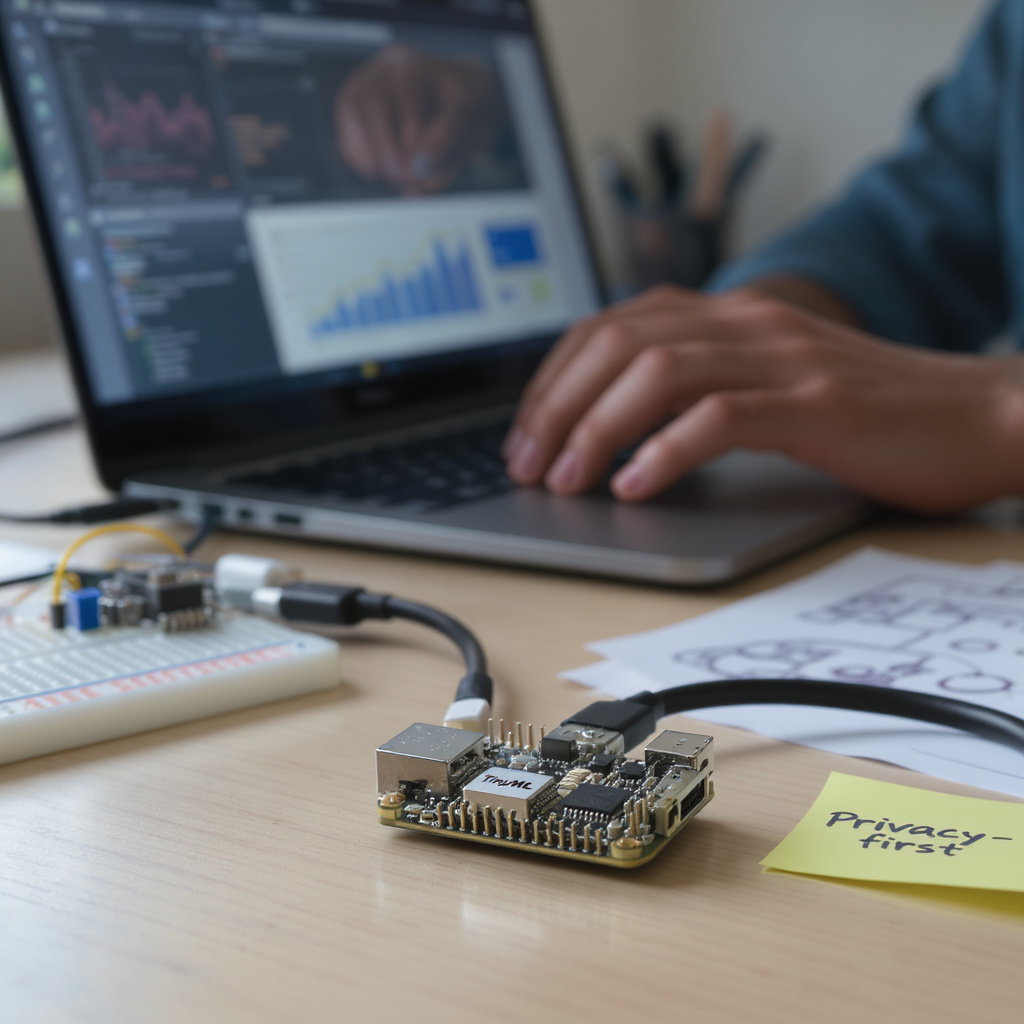
Problem: Many products still send raw sensor data to the cloud for intelligence. That causes latency, higher recurring costs, privacy exposure, and brittle behavior when connectivity fails — which harms user trust and product reliability.
Agitate: Imagine a wearable that delays fall alerts because of network lag, a remote sensor that burns batteries streaming audio, or sensitive health signals leaving a device without clear consent. These scenarios mean missed safety events, rising cloud bills, regulatory headaches, and frustrated users. Relying on distant servers also blocks features in offline or bandwidth‑constrained settings.
Solution — TinyML on the edge: Put compact models on-device to act instantly, preserve privacy, and cut operational cost. TinyML delivers:
- Real-time responses: low-latency inference for gestures, alarms, and control.
- Lower operational cost: reduced data transfer and cloud inference spend.
- Improved privacy: keep raw audio or health signals local and send only aggregated summaries.
- Higher reliability: local intelligence works during outages and extends battery life.
How to adopt it (practical steps):
- Start with a precise brief: set latency, accuracy, false-alarm tolerance, and a power budget.
- Collect real field data: capture representative signals with negatives and edge cases.
- Prototype fast: train lightweight models, profile accuracy vs. size, then test on target hardware.
- Optimize for MCUs: quantize, prune, and use efficient kernels (e.g., CMSIS‑NN); prefer TensorFlow Lite for Microcontrollers or Edge Impulse where supported.
- Measure on device: log latency, memory, and energy-per-inference with a power meter or built-in counters.
- Secure and respect privacy: ephemeral raw buffers, signed firmware/models, secure boot, and clear user consent for any telemetry.
- Pilot then scale: run a time-boxed field trial, collect lightweight telemetry, validate updates in staging, and enable safe rollbacks.
Fact-check and validation: Use MLPerf Tiny, vendor datasheets, and peer-reviewed case studies to ground claims. Always reproduce key measurements on your target board before committing to a design.
Bottom line: TinyML turns bulky, cloud-dependent features into fast, private, and efficient on-device experiences. Prototype small, measure in the wild, iterate with field data, and pilot carefully to earn users' trust and deliver tangible savings.