Reinforcement Learning: Practical Guide (Inverted Pyramid)
12/19/2025
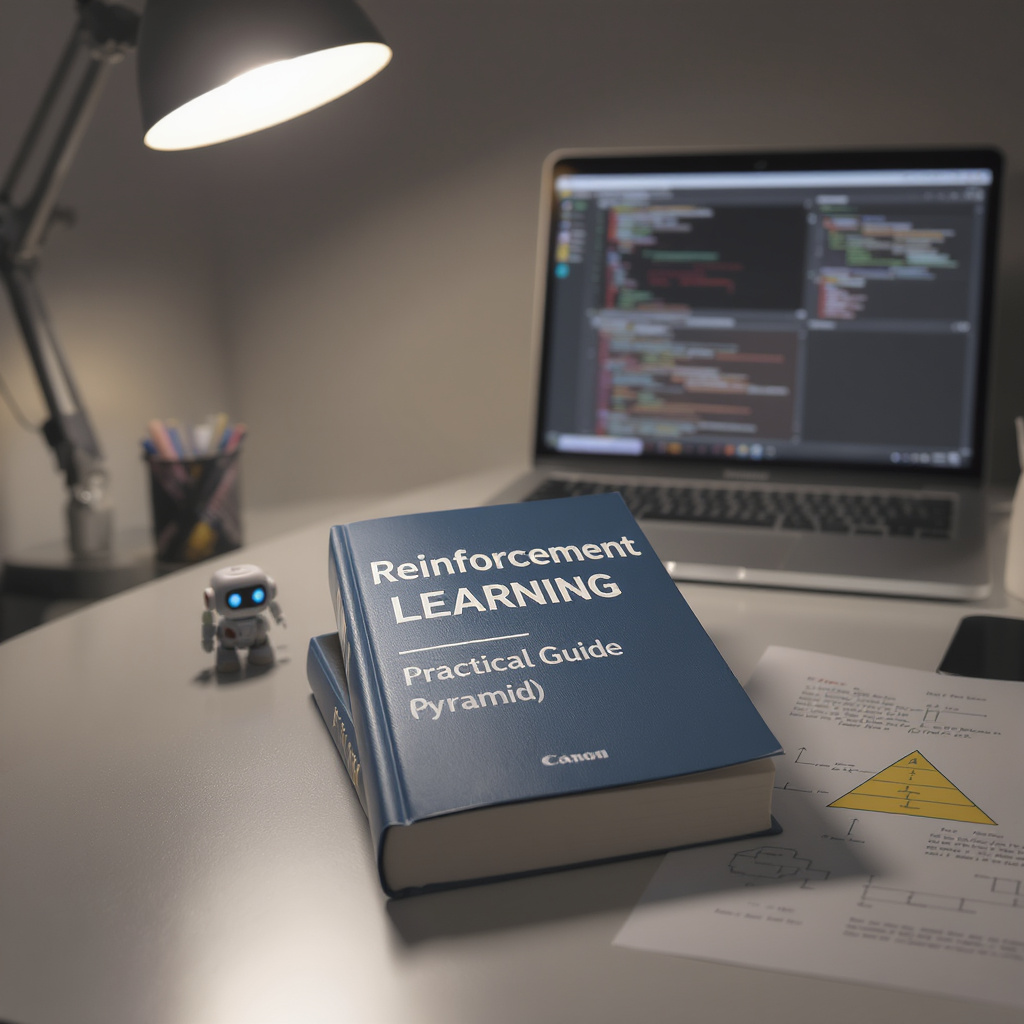
Main point: Reinforcement learning (RL) trains agents to make sequences of decisions that maximize long-term business value (for example, customer lifetime value, total margin, or service levels). Use RL when actions influence future states, long-term rewards matter, and safe exploration or simulation is available.
Why it matters and core advantages:
- Sequential optimization: RL optimizes whole decision chains rather than isolated predictions.
- Balancing short vs. long term: Policies explicitly trade immediate returns for future gains.
- Exploration capability: RL can discover better strategies under controlled exploration.
- Suitable domains: pricing, inventory, personalization, ad bidding, robotics, scheduling.
How it works (simple terms):
- Agent: the decision-maker (pricing engine, recommender, robot)
- Environment: the world it acts in (market, users, warehouse)
- State: observed snapshot (inventory, session data)
- Action: decision taken (price change, recommendation)
- Reward: feedback signal (profit, retention, cost)
Practical pathway (middle details):
- Start offline or in simulation: use logged trajectories or realistic simulators to train and stress-test.
- Design rewards carefully: align components to business KPIs, add penalties/constraints to avoid reward-hacking.
- Choose model family: value-based for discrete actions, policy/actor-critic for continuous or stochastic policies, model-based for sample efficiency.
- Validation stages: offline counterfactual evaluation (IPS, doubly robust), shadow runs, small randomized A/B tests, ramped rollout with rollback triggers.
- Monitoring & retraining: log trajectories, action probabilities, reward breakdowns, detect drift and retrain on triggers or schedule.
- Safety & governance: human-in-the-loop, audit trails, canary rollouts, align with NIST/EU AI Act guidance for high-risk systems.
Tools & metrics (bottom details and examples):
- Tooling: Stable-Baselines3, Ray RLlib, TF-Agents, Gymnasium, Isaac/MuJoCo/Unity for simulators.
- Metrics: separate short-term proxies from long-term KPIs; track reward variance, action-distribution drift, cohort retention.
- Validation tips: combine multiple OPE estimators, compare offline predictions to canary outcomes, restrict exploration in production.
- Quick checklist: define problem & KPIs, confirm data readiness, build simulator or augmentation plan, scope a narrow pilot, assemble cross-functional team.
Offer: MPL.AI helps design simulators, shape rewards, run robust pilots and instrument safe rollouts so teams can move from experiments to reliable automation.