Event Detection in Video — What, Why, How, What If
30/3/2026
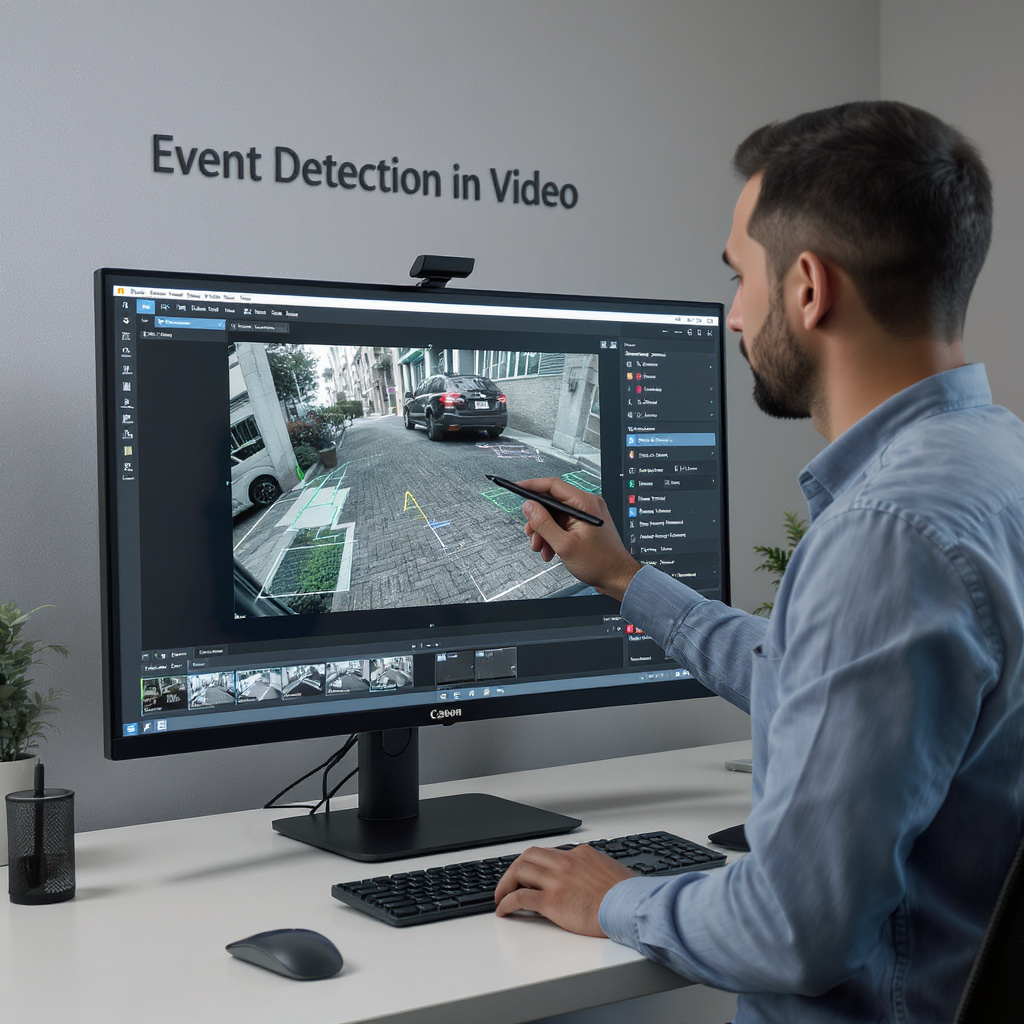
What: Event detection turns continuous video into timestamped signals — for example, a product pick in retail, a safety breach in manufacturing, a near‑miss at an intersection, or a goal in sports. Instead of watching hours of footage, teams receive concise, searchable moments they can act on.
Why: These signals speed response, reduce manual review, enable automation (alerts, highlights, workflows), and surface measurable operational improvements. Practical trade-offs matter: latency vs. accuracy (edge vs. cloud), privacy vs. visibility (anonymization and on‑device processing), and cost vs. coverage (camera count and resolution).
How: Build a clear pipeline that moves pixels to reliable events:
- Ingest & preprocess: normalize resolution/framerate, denoise, stabilize, and crop ROIs to focus compute.
- Per-frame detection: object detectors (YOLO, SSD, Faster R‑CNN variants) provide the what and where.
- Temporal reasoning: tracking (SORT/DeepSORT) + action classifiers or transformers link behavior over time to define events.
- Anomaly & rule layers: deterministic checks and statistical monitors complement learned models for interpretable alerts.
- Edge/cloud strategy: light edge models for low latency; richer cloud analysis for retrospective analytics and audits.
- Operations: confidence thresholds, deduplication, human‑in‑the‑loop review, continuous monitoring, and retraining on drift.
What if you don’t — or want to go further: Without these practices you risk false alarms, alert fatigue, and lost trust. Start with narrow pilots: collect representative video, define event‑level metrics (precision/recall, false alarms/day, latency), run a 2–4 week proof‑of‑concept with human review, and iterate. To scale, add data governance (retention, anonymization), synthetic or semi‑supervised data for rare events, and automation paths tied to clear success metrics.
Quick next steps: pick one camera and one use case, measure impact in operational terms, protect privacy by design, and instrument model health so the system continues improving in production.