7 Ways to Make AI Practical for Your Team
1/13/2026
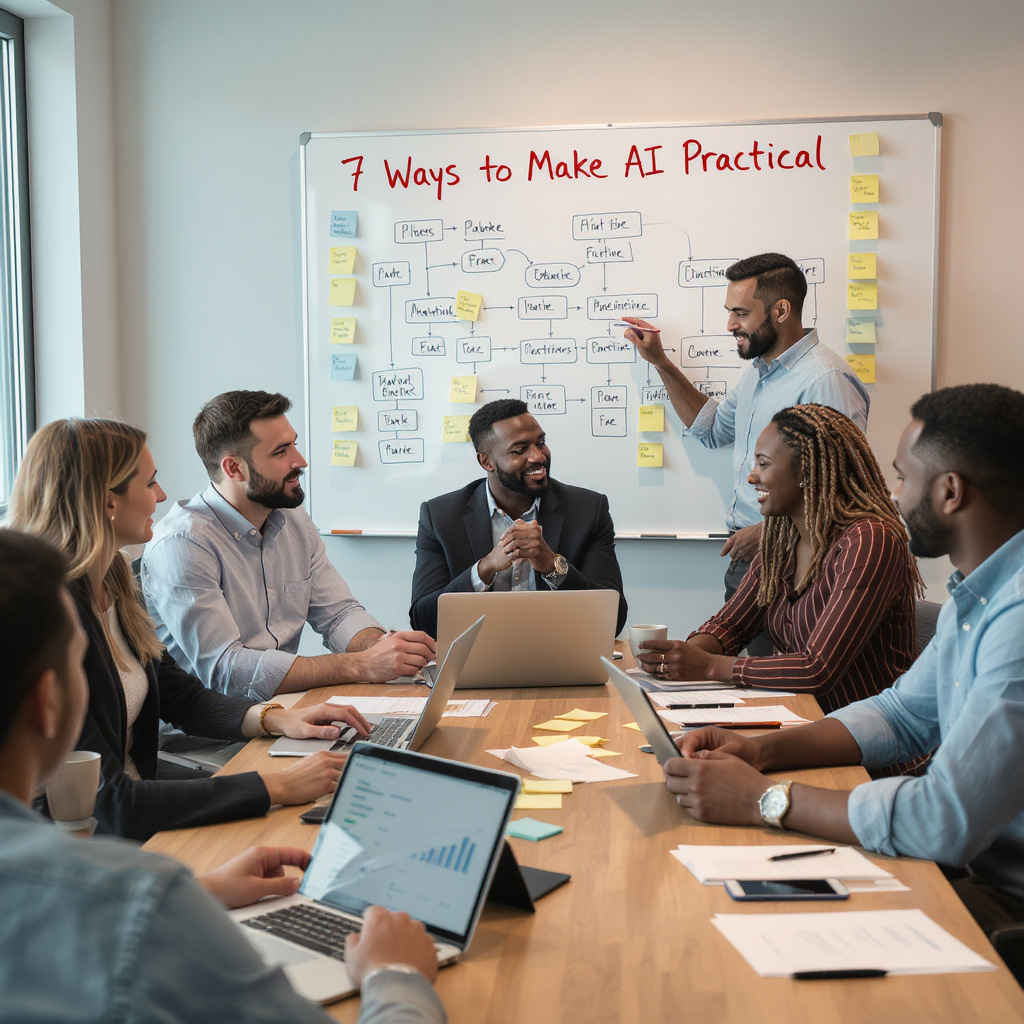
7 Ways to Make AI Practical for Your Team — a scannable, action-focused list to turn ideas into measurable results.
-
1. Start with clear value
Define which metric will change if the model works—shorter response time, fewer manual errors, lower cost, or higher satisfaction. Pick one measurable outcome as your success criterion.
-
2. Guarantee data readiness
Good AI begins with quality data. Verify coverage, consistency, and representative samples across key subgroups before modeling.
- Checklist: scope, coverage, missing values, privacy & access, maintenance plans.
-
3. Pilot fast and time‑box experiments
Run a focused 6–8 week proof of concept with defined success criteria, stakeholder involvement, and human oversight. Iterate quickly to reduce risk and secure buy‑in.
-
4. Bake governance and safeguards in from day one
Design privacy, bias testing, and transparency into project plans: limit data collection, apply access controls, anonymize where possible, and align with regulations like GDPR or HIPAA when relevant.
-
5. Embed human‑in‑the‑loop and clear escalation rules
Keep people in the loop for edge cases and high‑stakes decisions. Define who reviews automated outcomes, set thresholds for escalation, and require sign‑offs where safety or legal risk exists.
- Record inputs, model version, confidence scores, and business rules for each significant outcome.
-
6. Measure what matters and ground claims in evidence
Track a small set of KPIs tied to user impact: accuracy (overall and by subgroup), time saved, cost avoided, and user satisfaction. Start with a baseline, run A/B or controlled rollouts, and cite relevant studies or case studies where useful.
-
7. Scale thoughtfully with continuous monitoring
Move from POC to production by integrating into workflows, adding monitoring for performance and fairness, scheduling retraining for drift, and expanding only after repeatable gains are proven.
Used responsibly, AI amplifies judgment—not replaces it. Combine clean inputs, pattern‑aware models, and human oversight to unlock practical, measurable improvements across teams and industries.